a/bArithmetic · Fractions
Fraction Calculator you can see
Type fractions or mixed numbers the way you write them — 1 2/3 + 3/4 — and see every step, with fraction bars that show why.
- Free steps
- Graph
- Checked answers
Try it
Cut the bars into equal pieces.
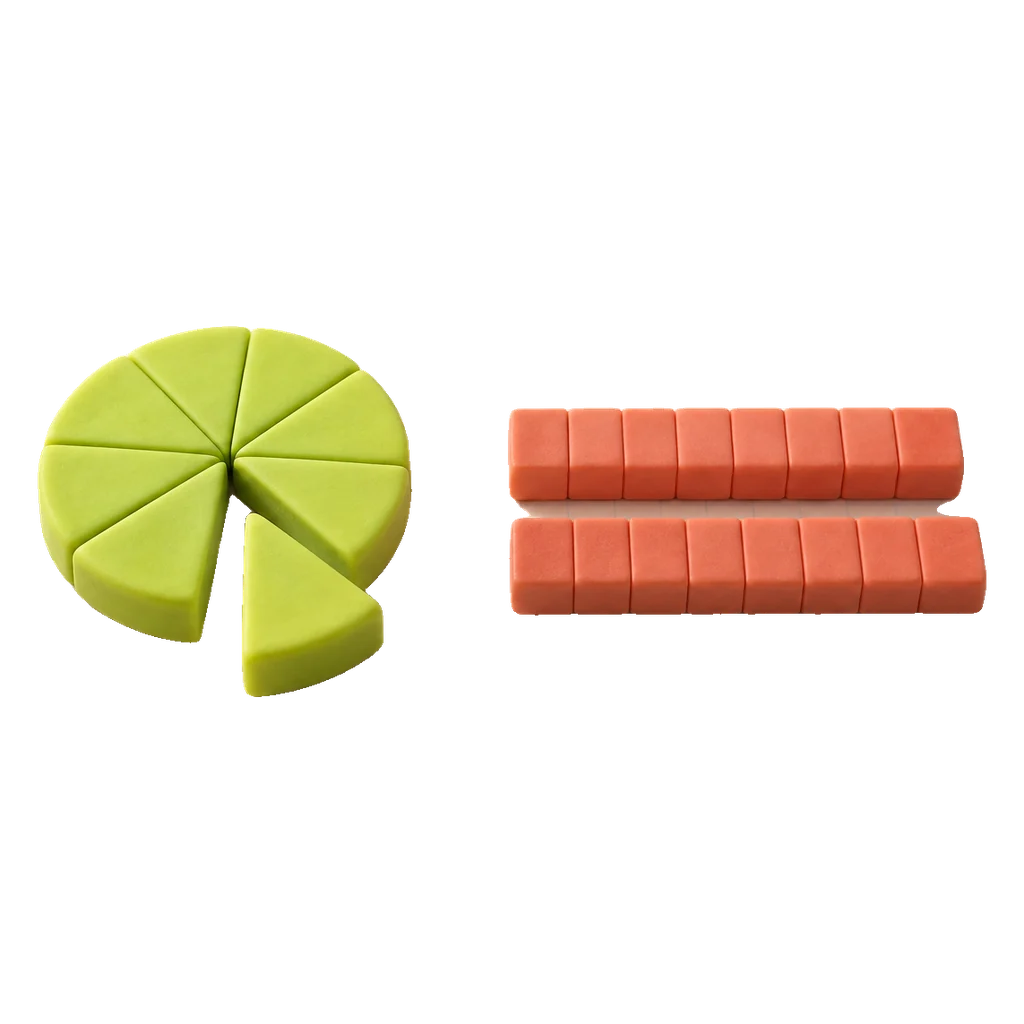
You can only add or subtract fractions when the pieces are the same size. Cut both bars into LCD-sized pieces and watch them line up.
1/2 and 1/3 are different sizes, so 1/2 + 1/3 is not 2/5. Cut both bars into equal pieces first.
Drag a bar, or focus it and use ← → to change its numerator. The ÷ steppers change the denominators.
Why this fraction calculator is different
01
LCD and HCF, two ways each
Common denominators are found by prime factors and by listing multiples; simplest form by listing factors and by prime factors — so the working matches whichever method your teacher uses.
02
Answers in the form you need
Simplest form, mixed number, decimal with the recurring bar (such as 0.416 bar) and percentage. Ask for one — “3/8 to a percentage” — and it comes first; whole-number answers stay whole.
03
Checked with decimals
Your problem is re-worked in ordinary decimal arithmetic by a separate parser and must match the exact fraction before the Verified stamp appears.
What is a fraction calculator?
A fraction calculator does exact arithmetic with fractions: it adds, subtracts, multiplies, divides and raises to powers fractions, mixed numbers such as 21/3, whole numbers, decimals and percentages — without turning everything into rounded decimals. A fraction a/b means a of b equal parts of a whole.
The hard part is usually the method: finding the lowest common denominator before adding, cancelling before multiplying, flipping the second fraction when dividing and dividing by the highest common factor at the end. This fraction calculator names each of those moves and shows the numbers, so you can follow — and check — your own working line by line.
Fractions run through school maths everywhere, from Year 6 and CBSE Class 6–7 arithmetic to GCSE number work and US middle-school math. Beyond arithmetic you can simplify a single fraction, convert between fractions, decimals and percentages, turn a recurring decimal such as 0.3 bar back into 1/3, and compare or order several fractions.
How to use the fraction calculator
- 1Type the problem with `/` for fractions and a space for mixed numbers: `2 1/3 + 1 3/4`. Use `+`, `-`, `×` (or `*` or `x`), `÷` and `^` for powers, with brackets when you need them. ½-style characters and `\frac{3}{4}` work too.
- 2Convert by asking: `3/8 to a percentage`, `0.625 as a fraction`, `17/5 as a mixed number`. Recurring decimals can be typed as `0.(3)`, `0.333…` or `0.3 recurring`.
- 3To compare or order, separate the numbers with commas: `3/4, 0.7, 2/3`. Add “from largest to smallest” for descending order, or type a statement such as `1/2 + 1/3 = 2/5` to test it.
- 4Open the steps to see the LCD, the rewritten fractions and the HCF; the Table tab shows the answer as a fraction, mixed number, decimal and percentage.
- 5Use Try a similar problem to practise until the method feels automatic.
Fraction calculator methods: the rules behind each step
Every answer is built from these rules:
Adding fractions with unlike denominators
Rewrite both fractions over the lowest common denominator so the pieces are the same size, then add or subtract the numerators: 1/2 + 1/3 = 3/6 + 2/6 = 5/6.
Multiplying fractions and cross-cancelling
No common denominator is needed. Cancel any factor shared by a numerator and the other denominator first to keep the numbers small; “of” means multiply, so 3/4 of 24 is 18.
Dividing fractions: keep, change, flip
Keep the first fraction, change ÷ to × and flip the second. Dividing asks how many of the second fit into the first: 6 ÷ 3/4 = 8.
Mixed numbers and improper fractions
Convert mixed numbers before multiplying or dividing. For adding and subtracting the calculator also shows the other classroom method: add the wholes and the parts separately, borrowing 1 when a fraction part is too small.
Simplest form with the HCF
Divide the top and bottom by their highest common factor: 18/24 = 3/4 because the factors of 18 and 24 share 6 at most.
Recurring decimals to fractions
Multiply by powers of 10 so the repeating tails line up, subtract, and solve. Going the other way, a fraction in simplest form terminates only when its denominator has no prime factors except 2 and 5.
Fraction calculator worked example: 1 2/3 + 3/4
- 01
Write the mixed number as an improper fraction.
12/3 = (1 × 3 + 2)/(3) = 5/3 - 02
The denominators 3 and 4 are different. Since 3 = 3 and 4 = 2^2, the lowest common denominator is 2^2 × 3 = 12.
lcm(3, 4) = 12 - 03
Rewrite both fractions over 12.
5/3 = 20/12, 3/4 = 9/12 - 04
Add the numerators and keep the denominator. The HCF of 29 and 12 is 1, so this is already in simplest form.
20/12 + 9/12 = 29/12 - 05
29 ÷ 12 = 2 remainder 5. As a decimal the remainder 8 keeps returning, so the 6 repeats.
29/12 = 25/12 = 2.416 bar
Mistakes the fraction calculator helps you avoid
Adding the denominators
1/2 + 1/3 is not 2/5. Only the numerators are added, once the denominators match. Type `1/2 + 1/3 = 2/5` and the calculator shows why the statement is false.
Flipping the wrong fraction when dividing
Flip only the second fraction (the divisor): 2/3 ÷ 4/5 = 2/3 × 5/4 = 5/6.
Multiplying mixed numbers part by part
21/2 × 21/2 is not 41/4. Convert first: 5/2 × 5/2 = 25/4 = 61/4.
Stopping before the simplest form
10/12 is correct but not finished — divide the top and bottom by the HCF, 2, to get 5/6.
Fraction calculator FAQ
How do you add fractions with different denominators?+
Find the lowest common denominator (the LCM of the denominators), rewrite each fraction over it by multiplying top and bottom by the same number, then add the numerators and keep the denominator. For 2/3 + 1/4 the LCD is 12, so 8/12 + 3/12 = 11/12. Simplify by the HCF at the end.
How do I enter a mixed number?+
Leave a space between the whole number and the fraction, as in `2 1/3`, or type `2 and 1/3`. A negative mixed number such as `-2 1/3` means -(2 + 1/3). Mixed numbers become improper fractions while working, and answers bigger than one are also given as mixed numbers.
How do you divide fractions?+
Use keep, change, flip: keep the first fraction, change ÷ to ×, and flip the second fraction upside down. Then multiply the tops and the bottoms, cancelling common factors first. For example 3/4 ÷ 2/5 = 3/4 × 5/2 = 15/8 = 17/8.
How do you simplify a fraction to its simplest form?+
Divide the numerator and the denominator by their highest common factor (HCF, also called the GCD). For 18/24, the largest factor shared by 18 and 24 is 6, so divide both by 6 to get 3/4. A fraction is in simplest form when the HCF is 1.
How do you convert a recurring decimal to a fraction?+
Call the decimal x, multiply by a power of 10 that moves one full repeating block past the point, and subtract the original so the repeating tails cancel. For x = 0.3 bar: 10x - x = 3, so x = 3/9 = 1/3. Type `0.(3)`, `0.333…` or `0.3 recurring` to see every line.
How do you put fractions in order from smallest to largest?+
Rewrite them over a common denominator and compare the numerators, or compare their decimal values. For 3/4, 5/6, 2/3 the LCD is 12, giving 9/12, 10/12, 8/12, so the order is 2/3 < 3/4 < 5/6. Add “from largest to smallest” to reverse the order.
Is the fraction calculator free, and how are answers checked?+
Yes, it is free to use with no sign-up. Every answer is computed with exact whole-number arithmetic, then the original problem is evaluated again with ordinary decimal arithmetic by a separate parser. The two must agree before the Verified stamp appears; otherwise the stamp is withheld.
Tools related to the fraction calculator
All calculatorsStuck on a different problem? Snap it.
Photo, typed or pasted — the maths solver reads it, solves it and checks the answer.